
Why Should Manufacturers Publish Blog Posts That Don't Generate Leads Directly?
If you run marketing for a manufacturing company, you’ve probably had this conversation more than once. Someone on the leadership team pulls up the blog, points at a post titled something like “A Brief History of Industrial Conveyor Belts,” and asks the question that kills a lot of good SEO programs: “How many leads did this one bring in?”
The honest answer is usually zero. Not a single form filled out. Not a quote request. Nothing you can tie to the pipeline in HubSpot or Salesforce.
And yet that post, and fifty more like it, might be the reason your cornerstone product page ranks at all. That’s the piece most operators miss. Informational content on a manufacturing site isn’t there to convert. It’s there to make the conversion pages work in the first place.
Let’s break down why.
The Job of a Product Page vs. the Job of a Blog Post
A product page has one job: close. It exists for buyers who already know what they want, who are evaluating vendors, and who are ready to request a sample, a datasheet, or a quote.
A blog post on that same site has a completely different job. It exists for buyers who don’t yet know they need you, for engineers researching a spec, for procurement managers comparing materials, and for the search engines trying to decide whether your domain is a credible authority on the topic at all.
When you only publish commercial pages, you’re asking Google to trust you on a topic you’ve barely written about. That’s a weak position. Competitors who publish deeply on the same subject signal more expertise, and they tend to outrank you even in the money terms you care about.
Informational Posts Build Topical Authority
Topical authority is the accumulated signal that your site is a genuine source on a subject, not just a storefront selling something inside it.
For a valve manufacturer, that means Google needs to see you writing about flow rates, pressure drop calculations, material compatibility, corrosion behavior, installation best practices, and failure modes. Not just product SKUs. Every informational post adds another piece to the mosaic. Over time, that mosaic is what lets your actual product pages punch above their weight in rankings.
Sites with strong topical coverage rank better for high-intent queries even when their product pages are thinner than competitors’. The blog isn’t a separate project from your commercial SEO. It’s the foundation it sits on.
AI Search Pulls From Informational Content, Not Product Pages
This is the part that’s changed fastest, and most manufacturing marketers haven’t caught up yet.
When a prospect asks ChatGPT, Perplexity, Gemini, or Google’s AI Overviews a question like “What’s the best gasket material for food-grade applications?” the answer is assembled from content that actually explains the trade-offs. Not from a page whose only content is a product spec sheet and a “Request a Quote” button.
If your informational posts don’t exist, you don’t get cited. And if you don’t get cited inside AI-generated answers, you lose visibility at the exact moment when a meaningful slice of research is shifting away from the ten blue links.
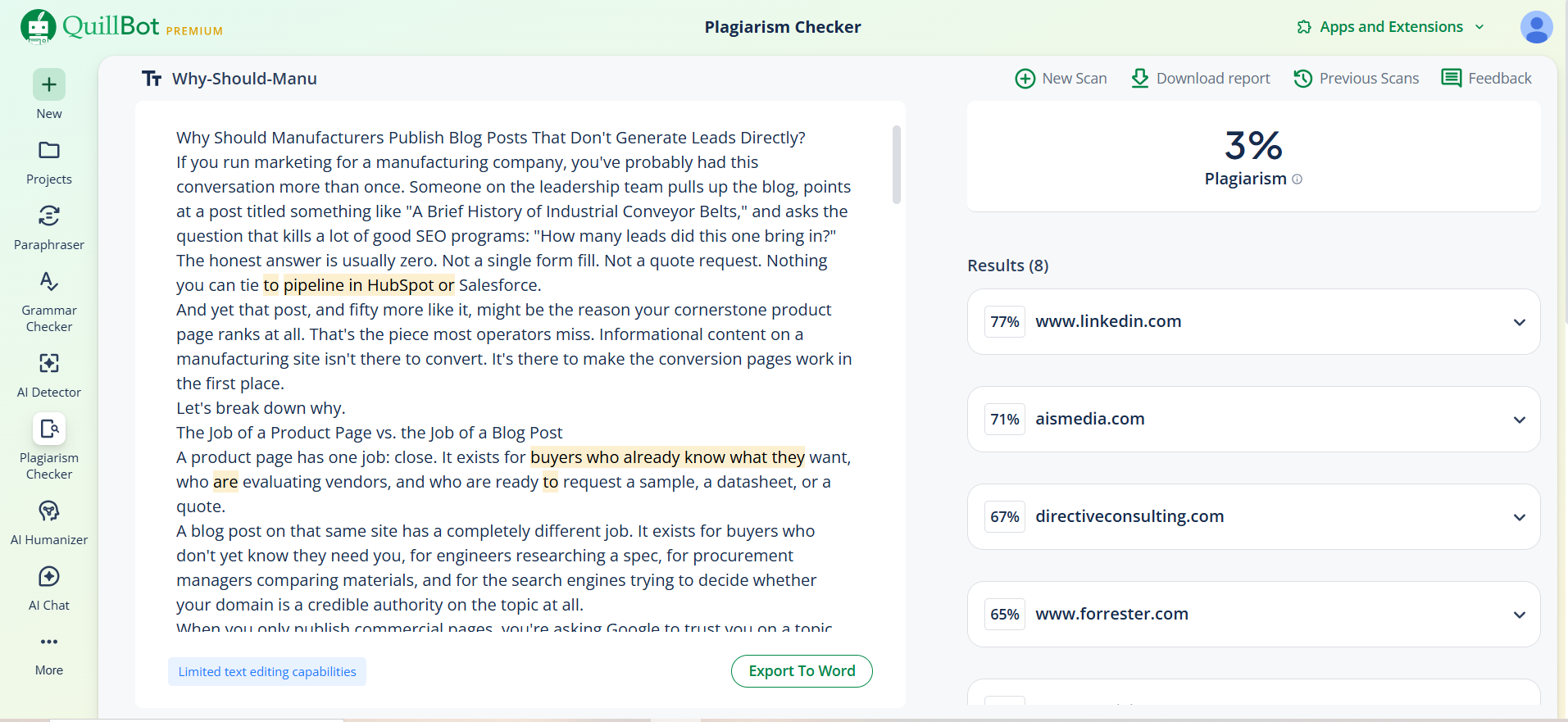
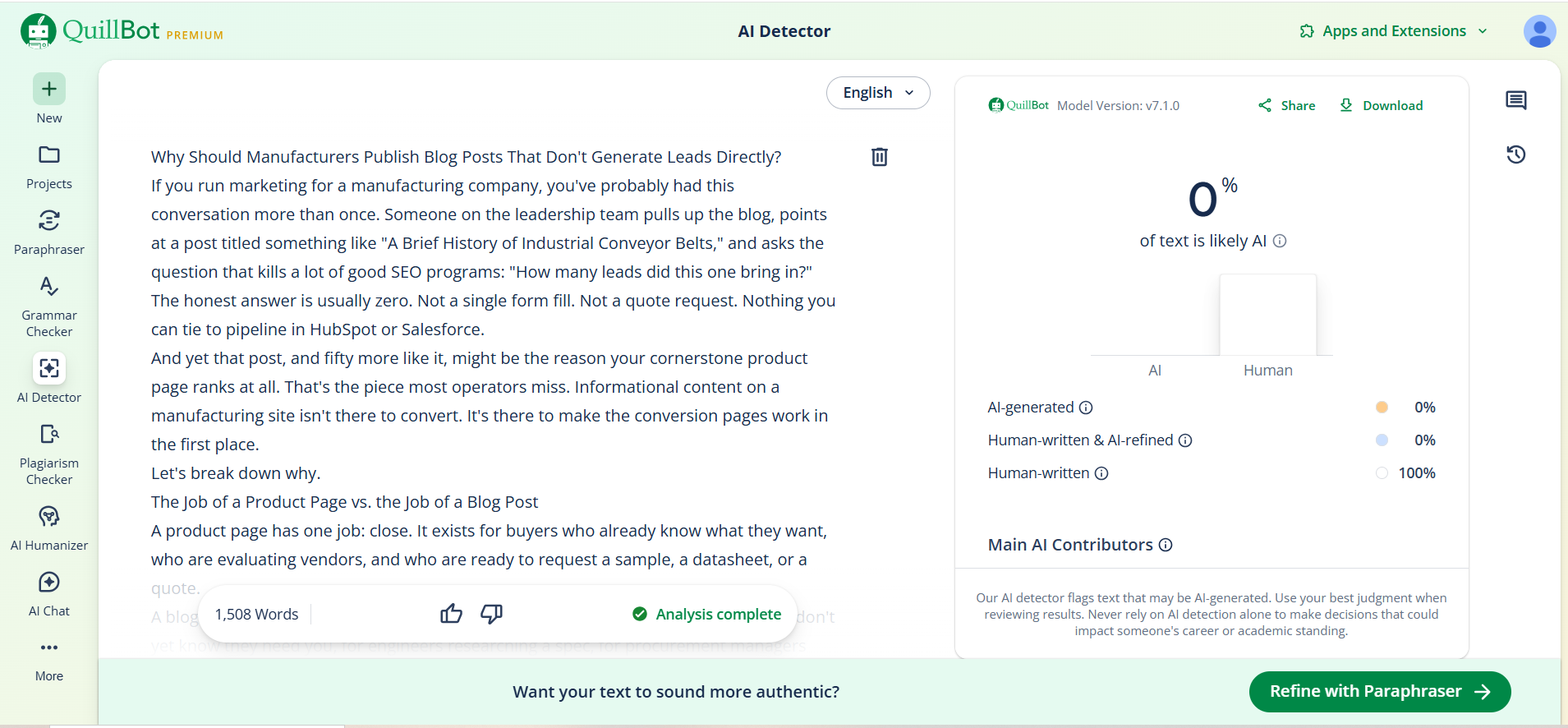
There’s a related trap worth flagging. A lot of manufacturers, under pressure to publish faster, have started running raw AI output onto their blogs without editing it. That’s a problem on two fronts. It reads generic, which doesn’t build trust with technical buyers. And it tends to trip AI detection signals that both Google and LLM systems are getting better at weighting. If you or your team are leaning on AI drafts to keep up with a content calendar, run them through a Humanize AI tool before publishing so the final copy reads as if it came from a person who actually knows the subject. That one extra step is the difference between content that earns citations and content that gets ignored.
Informational Content Is What Earns Backlinks
Here’s a test. Go look at the last time a trade publication, an industry blog, or a university engineering resource linked to a manufacturer’s website. What did they link to?
It wasn’t the product catalog. It was a guide, a data-heavy explainer, a case study, or a piece of original research. Commercial pages almost never attract links on their own because nobody wants to link to something that reads like a sales pitch.
If your backlink profile is thin, the usual cause isn’t your outreach effort. It’s that you don’t have anything worth linking to. Informational posts are the asset that makes the rest of your link building even possible. Without them, your team is stuck begging for product-page mentions that editors will almost always decline.
Relevance Is a Moving Target
Manufacturing SEO is more competitive than it looks from the outside. You’re not just competing with other manufacturers. You’re competing with distributors, marketplaces, engineering forums, and content-heavy sites that publish daily.
Freshness matters. So does coverage breadth. A site that publishes informational content consistently signals to search engines that it’s active, maintained, and worth indexing. A site that only updates when a new product launches signals the opposite, which is that nobody’s home.
You don’t have to out-publish everyone. But you do have to publish enough, and deeply enough, to stay in the conversation.
How Informational Posts Actually Support Revenue
Let’s reframe the original objection. “This post didn’t convert” treats each blog post as a standalone revenue event. That’s the wrong unit of analysis.
The right way to think about it:
- An informational post brings in a reader who’s researching, not buying.
- That reader doesn’t convert on the post. They may not convert for months.
- But that same post raises your topical authority, which lifts your product page rankings, which brings in more high-intent traffic, which does convert.
- It also earns backlinks, which strengthen the whole domain.
- And it shows up as a citation in AI-generated answers, which puts your brand in front of prospects before they’ve even visited a vendor site.
The blog post didn’t generate the lead. But the lead exists because the blog post existed. If you strip out the informational content, the conversion pages quietly stop performing, and the drop usually doesn’t show up in analytics until six to nine months later, by which point the damage is expensive to reverse.
What Manufacturers Should Actually Be Publishing
If you’re going to commit to this strategy, publish content that technical buyers genuinely want:
- Material and specification guides. Comparisons, tradeoffs, and use-case fits.
- Application notes. How your product category performs in specific industries or environments.
- Troubleshooting and failure analysis. Real problems, real diagnostics.
- Standards and compliance explainers. ASTM, ISO, FDA, whatever governs your space.
- Original data. Test results, benchmark studies, and survey data from your customer base.
Avoid generic “5 benefits of our product” posts. They don’t rank, they don’t earn links, and AI systems won’t cite them.
The CEO Framing
If you’re the person defending the content budget to a skeptical leadership team, this is the argument that tends to land.
Informational content is infrastructure. You don’t evaluate infrastructure by asking which pipe delivered a specific paying customer. You evaluate it by asking whether the whole system would function without it.
For manufacturing SEO in 2026, the honest answer is no. Strip out the informational layer, and what’s left is a commercial site with no authority, no inbound links, no AI visibility, and rankings that slowly erode. That’s not a blog problem. That’s a pipeline problem, and it eventually shows up in the revenue line.
Publish the posts that don’t convert. They’re paying for the ones that do.
Still Have Questions?
1. How long does it take for informational content to start supporting product page rankings?
Realistically, six to twelve months for a site with average authority. The effect compounds, so the first cluster of posts does less than the third or fourth. If you’re evaluating results at the three-month mark and calling the program a failure, you’re cutting it before the curve bends. Give a topical-authority play at least two quarters before making a call.
2. How many blog posts should a manufacturer publish per month?
Depth beats volume. Two well-researched posts per month that genuinely answer a technical question will outperform eight thin posts every time. If your team can sustainably produce one deep piece a week; that’s a strong cadence. If it’s one every two weeks, that still works provided the quality is there and you’re covering a coherent topic cluster rather than publishing randomly.
3. Can I use AI to write manufacturing blog posts?
You can, but not in the way most teams are doing it. Raw AI drafts tend to read generic, skip the specific details that technical buyers notice, and get flagged by the same systems you’re trying to rank in. Use AI for research synthesis, first drafts, and outlining. Then have a subject matter expert add the specifics, examples, and opinions that only someone inside the industry would know. The final piece should be something your best engineer would read without rolling their eyes.
About Nimisha Shttps

Nimisha Shttps is a SaaS (Software as a Service) content writer at Anchorial, a link-building agency. With extensive experience writing for SaaS brands from early-stage startups to established platforms, she specializes in turning complex products into clear, compelling narratives that rank, resonate, and convert.