
Custom Website Development for Manufacturers
Website development is the technical process of building and maintaining a website, covering everything from server infrastructure and code architecture to database integrations, performance optimization, and content management systems. It is distinct from web design, which focuses on the visual and structural layer. Development is what makes a website fast, secure, scalable, and functional at every user touchpoint.
For manufacturers, Lform handles this entire technical process in-house. Since 2005, we have built websites for manufacturers across the East Coast and throughout the United States, from companies with a handful of core products to industrial distributors managing thousands of SKUs across multiple markets.
Why Website Development for Manufacturers Is Different
Not all website development projects are equal. A consumer e-commerce site, a SaaS platform, and a manufacturing website operate under fundamentally different conditions, serve different audiences, and need to accomplish different things.
Manufacturing websites serve multiple distinct audiences at once: procurement managers evaluating vendors, engineers verifying technical specifications, distributors looking for product data, and executives assessing long-term fit. Each group arrives with different questions and follows a different path through the site. The development architecture needs to accommodate that complexity without making the experience feel complicated.
Manufacturing sales cycles are long. A prospect may visit a website a dozen times over several months before submitting an RFQ or contacting a sales representative. The site has to hold up through that process, providing the right information at each stage and making it easy to take the next step, whether that is downloading a spec sheet, requesting a sample, or starting a conversation with the sales team.
There is also the technical product layer. Many manufacturers deal with extensive product catalogs, regulated pricing, ERP and CRM dependencies, and highly specific search behavior. Getting those systems to communicate reliably with the website, and keeping the data consistent without creating extra work for the client’s internal team, is a core development challenge. It requires experience with the tools manufacturers actually use, not just general web development frameworks.
Lform works exclusively with manufacturers and B2B industrial companies. That vertical focus means we understand these requirements before the first meeting. Our services for manufacturers are built around the realities of industrial buying, not adapted from a generic agency playbook.
Why a Well-Developed Website Matters for Manufacturers
A website is often the first place a prospective buyer evaluates whether a manufacturer is a credible, capable partner. Before any conversation with a sales representative happens, decision-makers use your website to answer foundational questions: Can this company handle our volume? Do they work with companies in our industry? Do they have the technical depth to support our requirements?
A poorly developed website signals risk. Slow load times, broken integrations, outdated product information, and confusing navigation all undermine credibility at the exact moment when trust is being formed. In manufacturing, where contracts are high-value and relationships are long-term, that first impression carries significant weight.
A well-developed manufacturing website does the opposite. It positions the company as organized, capable, and easy to work with. It surfaces the right information for each audience without requiring them to work for it. And it connects online activity to the sales pipeline, ensuring that qualified inquiries reach the right people with the context they need to follow up effectively.
For manufacturers looking to grow, a website is not an overhead cost. It is a business development tool. One that works continuously, serves every market you operate in, and scales alongside your company.
Structuring Manufacturing Websites for RFQs and Lead Generation
Generating qualified leads from a manufacturing website requires more than a contact form buried in the footer. The structure of the site itself has to support the way industrial buyers actually evaluate and decide.
Build Clear Paths for Each Audience
Engineering teams, procurement managers, and executive buyers are not looking for the same thing. The navigation, page hierarchy, and internal linking structure should create clear, intuitive routes for each group. A procurement manager needs to reach capabilities and certifications quickly. An engineer needs access to technical documentation, tolerances, and material specifications. A business owner wants to understand the company history, client references, and service scope.
When every visitor type can find what they need without friction, the site converts more of its traffic into qualified conversations.
Place RFQ and Quote Requests Strategically
An RFQ form that only lives on the contact page will miss conversions. On manufacturing websites, the request-for-quote pathway should appear near the product and capability information that triggers the decision to reach out. That means contextual CTAs on product pages, service pages, and capability overviews, not just a single form on a standalone page.
The form itself matters too. Long, generic forms create drop-off. Short, focused forms that ask for the information your sales team actually needs to respond intelligently will generate higher-quality submissions.
Support the Full Research Phase
Industrial buyers frequently spend weeks or months in research before any contact with a vendor. Your website needs to support that phase with content that answers technical questions, demonstrates industry experience, and builds confidence in your process. Case studies, capability statements, certifications, and clearly described service scopes all serve this function.
A well-developed site surfaces this content to search engines as well as visitors, increasing visibility for the specific terms your prospects are searching during the research phase.
What Lform Builds for Manufacturing Websites
Every manufacturing website Lform develops is built around the specific goals, audiences, and operational context of that client. The technical deliverables vary by project, but the foundation is consistent: stable architecture, clean integrations, and a site your team can maintain without calling a developer for every update.
Platform and architecture. Platform selection is one of the first decisions we make with a client, and it has long-term consequences. WordPress and Statamic are our primary recommendations for manufacturers because both have mature ecosystems, strong security track records, and content management interfaces that non-technical teams can actually use after launch. WordPress suits manufacturers who need a widely supported platform with a broad plugin ecosystem and straightforward editorial workflows. Statamic is a better fit for companies with more complex content structures, stricter version-control requirements, or development teams that want cleaner architecture under the hood. Headless and custom solutions are available for more complex requirements. In every case, the decision is driven by your team’s capabilities and your site’s long-term requirements, not by what is easiest for us to build. The goal is always a setup that is fast, secure, and manageable after launch.
ERP, CRM, and third-party integrations. We connect manufacturing websites to the systems your team already uses. Whether that means syncing product data from an ERP, routing form submissions to a CRM, or building a quote request flow that feeds directly into your sales process, we handle the integration work in full. Your team saves time; your data stays consistent.
Performance, security, and accessibility. Page speed affects both search rankings and user experience. Security matters especially when a site handles customer data, pricing information, or quote submissions. Accessibility ensures your site is usable across your full audience. We address all three from the beginning of development, not as afterthoughts.
Content management and governance. After launch, your team needs to be able to confidently update the site. We set up the CMS with clear editorial workflows, provide documentation, and train your staff so ownership transfers cleanly. A site that requires constant agency involvement to maintain is a liability. Ours are built to be owned.
Technical SEO foundations. Every website we develop is built with technical SEO best practices embedded from the ground up, with clean URL structures, proper heading hierarchy, fast load times, crawlable architecture, and mobile performance that meets current search standards. Websites for manufacturers need to be found before they can generate leads, and a technically sound build is the prerequisite for any SEO strategy to take hold. For manufacturers who want to continue that work after launch, Lform has an in-house team of SEO specialists who can build on the foundation we’ve laid.
Built to Last: Maintainable Websites for Manufacturers
One of the most common reasons manufacturers come to Lform is that their current site has become a burden. It is slow to update, difficult to modify, dependent on a developer for routine changes, or built on a platform that no longer fits the business.
We design websites for manufacturers with long-term maintainability as a primary objective. That means clean, well-documented code, a CMS configuration that reflects how your team actually works, and technologies with long support lifecycles and strong ecosystems rather than whatever happens to be new.
It also means we build with the expectation that your business will change. New product lines, new markets, acquisitions, rebranding — a well-built site should absorb those changes without requiring a full rebuild. Protecting your investment is not a selling point we use lightly. It is a specific technical and architectural commitment embedded in how we build.
How We Work
Every project follows a structured process with clear milestones and consistent communication throughout. For manufacturers operating on long sales cycles, predictability matters — both in what gets built and in how the project is managed.
- Discover. We start by understanding your business: your audiences, your sales process, your current site’s gaps, and what success looks like at 12 months. This phase shapes every decision that follows.
- Plan. We define the site structure, page types, content requirements, and integration specifications before any design or development work begins. You know exactly what is being built and why before we write a line of code.
- Build. Development, integration work, and content entry happen in staged environments with regular previews. You review progress at defined intervals, not at the end when changes are costly.
- Launch. We handle redirects, quality checks, performance validation, and go-live coordination. Launches are planned, not rushed.
- Post-launch. Training, documentation, and handoff are part of every project. Many of our clients continue working with us after launch, expanding their site and strengthening their digital presence through SEO, new content, and ongoing development support.
A Look at What We’ve Built for Manufacturers
Our work with manufacturers spans industries, scales, and levels of technical complexity. A few examples from our case studies:
Atlantic Equipment Engineers
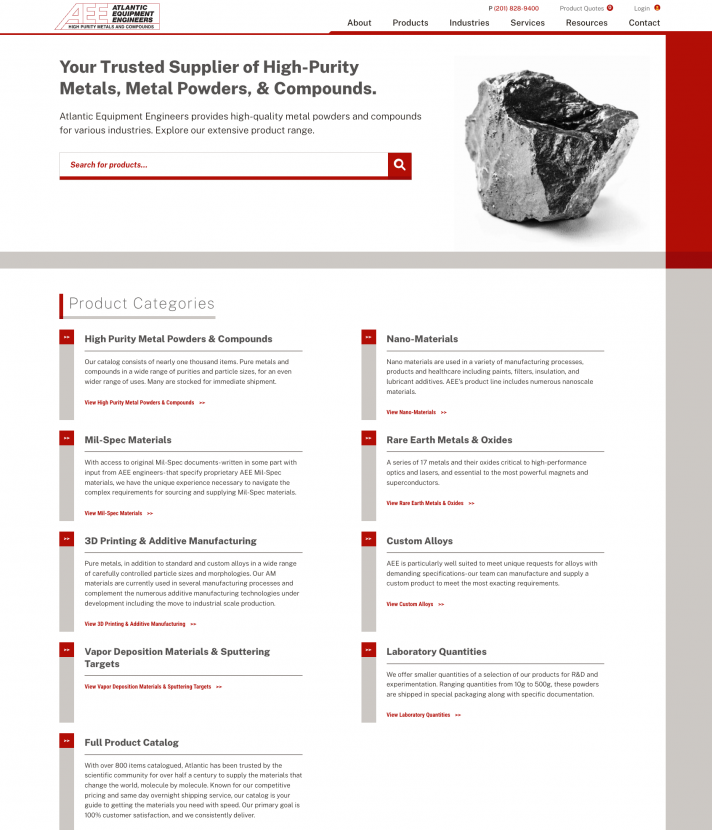
Atlantic Equipment Engineers is a high-purity metals supplier with an extensive regulated product catalog and pricing that fluctuates with global supply chains. The core development challenge was building a quote-request system — not a standard checkout flow — that connected directly to their Sage ERP. We repurposed WooCommerce to handle quote submissions rather than transactions, built a custom pricing tier system based on order volume, and created a secure data bridge between the website and Sage that eliminated double data entry. The result was a catalog-driven site that reduced internal workload while making the quote process clear and accessible for Atlantic’s technical buyers.
Hockmeyer Equipment Corp.
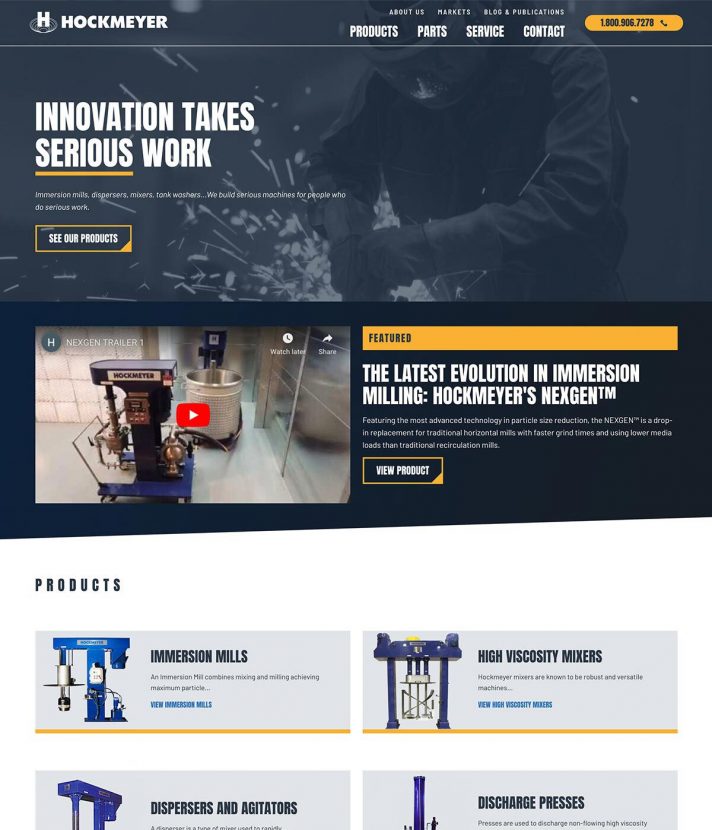
Hockmeyer Equipment Corp. manufactures custom milling technology where every machine is bespoke and no two orders are alike. The website’s primary job is lead generation and brand credibility. The development challenge here was performance: a homepage built around multiple video assets and heavy imagery that initially loaded too slowly to be viable. We optimized the resource load sequence so third-party assets like YouTube embeds and reCAPTCHA only initialize when they are needed, bringing page speed to a level that supports both rankings and user experience. We also built the site with future integrations in mind, so ERP or CRM connections can be added as the company grows without requiring structural changes.
Pabco Gypsum
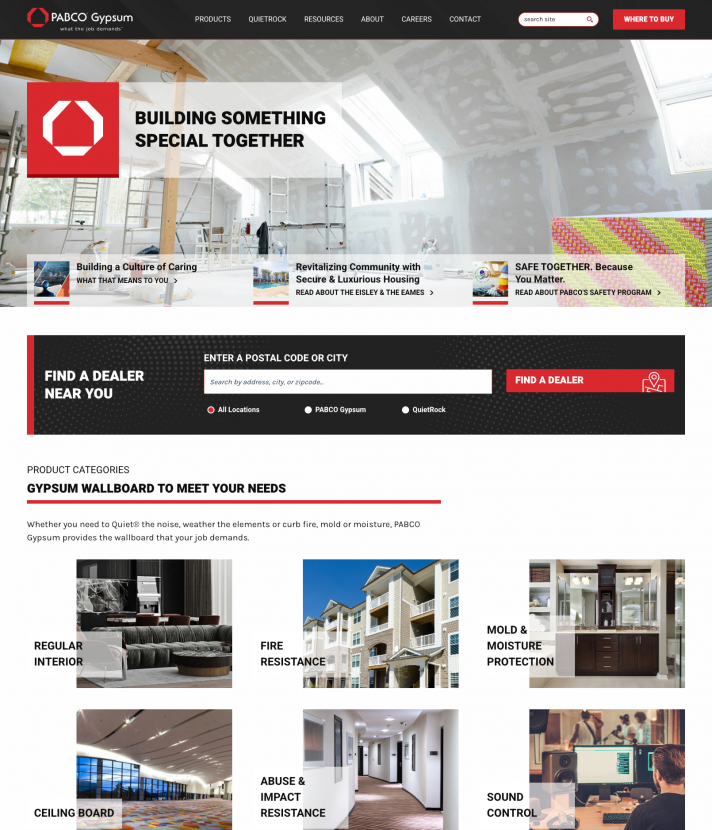
Pabco Gypsum needed a platform capable of consolidating their full product offering across a large and diverse catalog while remaining navigable for industry professionals with specific, technical search intent. The development work focused on information architecture and discoverability — ensuring that the right products and resources surfaced to the right audiences without overwhelming the experience. See the before and after to understand the scope of this transformation.
Discuss Your Project With Our Team
Ready to Build a Website That Works as Hard as You Do
A manufacturing website should generate qualified leads, support your sales team, and reflect the quality of what your company actually produces. If your current site is not doing that, the gap is rarely just one thing. Sometimes the issue is structural: poor information architecture, weak conversion paths, or integrations that never worked properly. Sometimes it is visual: a site that looks outdated signals to prospective buyers that the company behind it may be too. Most of the time, it is both.
Lform has been building websites for manufacturers since 2005. Our entire team is in-house, our focus is exclusively on manufacturing and industrial B2B, and every project is built with the goal of sustained, measurable results.
Schedule a needs assessment to talk through your goals, or contact us if you have a specific project in mind.
Your Questions About Manufacturing Website Development, Answered
Below you’ll find the most common questions manufacturers ask us about website development. Have something more specific in mind? Reach out to our team and we’ll point you in the right direction.
What is website development?
Website development is the technical process of building and maintaining a website, which covers code architecture, server infrastructure, database management, third-party integrations, performance optimization, and content management systems. It is distinct from web design, which focuses on the visual and structural layer. Development is what makes a website functional, fast, secure, and scalable.
What does website development for manufacturers include?
For manufacturers, website development typically includes platform setup, ERP and CRM integrations, product catalog architecture, RFQ and lead generation functionality, performance optimization, and CMS configuration so your team can manage content after launch. The scope depends on the complexity of your products, the systems you already use, and the audiences your site needs to serve.
Why do manufacturers need a specialized approach to website development?
Manufacturing websites serve multiple technical audiences — procurement managers, engineers, distributors, and executives — each with different needs and different points in the buying process. They also rely on integrations with systems like Sage, NetSuite, or Salesforce, require quote-request functionality rather than standard e-commerce flows, and need to support long sales cycles where a prospect may research for months before making contact. A generalist development approach rarely accounts for any of that.
How should a manufacturing website be structured to support lead generation?
Lead generation on a manufacturing website depends on clear audience pathways, contextual RFQ prompts near product and capability content, short forms that collect what your sales team actually needs, and a content structure that supports the research phase. Visitors who find what they need quickly and can request a quote without friction are far more likely to convert.
How do you get a manufacturing website that performs well on all devices?
Cross-device performance is a development concern as much as a design one. On the development side, it requires flexible code architecture, properly optimized media, and thorough testing across screen sizes and browsers. For manufacturers whose buyers increasingly research on mobile before making decisions at the desk, a site that loads slowly or breaks on smaller screens loses credibility before a conversation even starts.
Why isn’t my manufacturing company’s website generating leads?
There are several common causes: unclear navigation that makes it hard for visitors to find the right information, no prominent or well-placed RFQ pathways, slow load times that increase bounce rates, content that doesn’t address the specific questions your buyers have, or technical issues that prevent the site from ranking in search. Often, it is a combination of structural and technical problems working against each other.
How long does it take to develop a manufacturing website?
Timelines vary by scope. The number of pages, the complexity of integrations, and the volume of content all affect how long a project takes. At Lform, every project moves through a defined process: discovery, planning, build, and launch, with clear milestones at each stage. After an initial conversation about your goals and requirements, we provide a realistic timeline based on your specific project.
What CMS platforms are best for manufacturing websites?
WordPress and Statamic are the two platforms we recommend most often for manufacturers. WordPress suits companies that need a widely supported platform with straightforward content management. Statamic is a better fit for more complex content structures or teams with stricter version control requirements. The right choice depends on your team’s capabilities and how the site needs to grow over time.
Can my team manage the website after launch without a developer?
Yes, and that is a requirement we build toward, not an afterthought. We configure the CMS to reflect the way your team actually works, provide documentation, and train your staff before handoff. The goal is a site your team owns and can maintain confidently, without being dependent on an agency for routine updates.
Do you work with manufacturers outside of New Jersey?
Yes. While Lform is headquartered in New Jersey and works extensively with manufacturers across the East Coast, we support manufacturing companies throughout the United States. Remote collaboration, clear documentation, and structured communication keep projects moving regardless of location.