
Factors that Influence Search Engines' Trust in Manufacturing Websites
Google’s algorithm hasn’t always worked the way it does today. For years, ranking was largely a keyword game. Stuff the right terms into a page often enough, and visibility would follow. That changed with a series of major algorithm updates.
Panda, launched in 2011, was the first major update to target low-quality content, thin pages, and content farms. Penguin followed in 2012, tackling manipulative link schemes. Then came Hummingbird in 2013, a core algorithm overhaul that improved Google’s ability to understand the meaning behind a query, not just the words. Later updates like RankBrain and the Helpful Content system pushed that shift further, making content quality and user intent central to how pages are evaluated.
Today, Google prioritizes credibility, consistency, and authority before deciding which sites deserve visibility in SERPs. For manufacturing websites, that shift matters. Trust is often the key factor that separates a site generating high-value leads from one that gets buried in search results.
Key Factors that Impact a Manufacturing Website’s Trust in SERPs
E-E-A-T Signals
E-E-A-T stands for Experience, Expertise, Authoritativeness, and Trustworthiness. It is a set of guidelines primarily used by Google’s human raters to measure content quality signals.
Experience: It focuses on first-hand and real knowledge of the manufacturing industry. A manufacturing website that showcases real projects, factory images, case studies, and more tends to appear trustworthy for Google.
Expertise: This element focuses on the accuracy and depth of the content. A website that comes with relevant, unique, and valuable content consistently will have a good authority in search results.
Authoritativeness: This is built over time by earning certifications, awards, and membership in different industrial organizations, showcasing the manufacturing website’s brand authority.
Trustworthiness: It showcases transparency and credibility to search engines. Clear contact information, privacy policies, payment methods, and customer testimonials help users and search engines to trust the website.
In the context of a manufacturing website, E-E-A-T becomes even more important. This is because industrial customers usually search for technical information online before making the final decision about the purchase.
Strong E-E-A-T signals improve how both search engines and users perceive your site.
Backlinks Quality
Backlinks are a confirmed Google ranking factor. They act as a signal of authority and relevance for search engines.
However, it is important to note that the quality of the link matters far more than the quantity. When a manufacturing website earns a backlink from a relevant source like an industrial blog, trade publication, or business association, Google treats it as a strong endorsement that can improve your site’s visibility.
For this reason, a manufacturing website needs to acquire only quality links and keep track of them using advanced tools like Semrush.
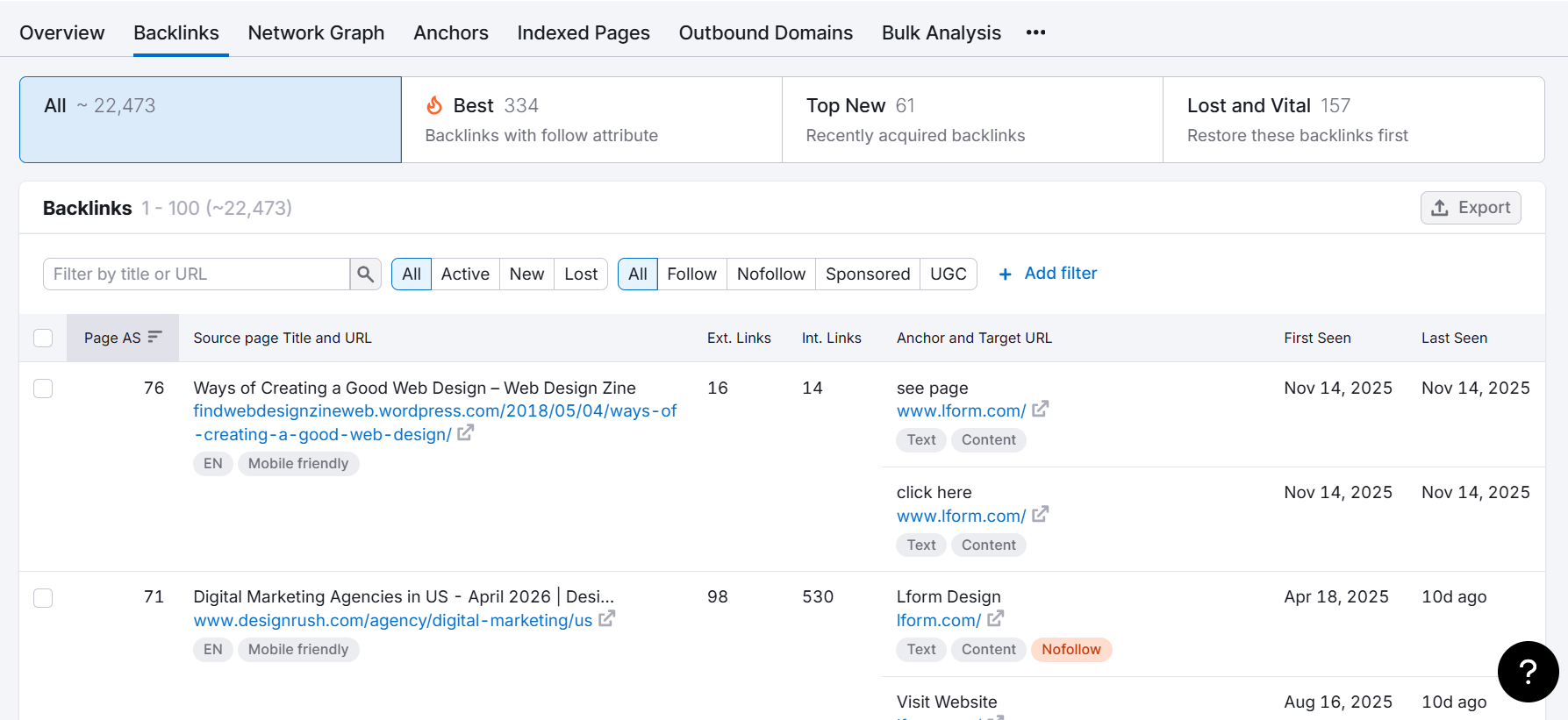
Semrush provides a detailed list of backlinks coming from other sites, along with different insights such as link type and anchor text.
Domain Authority Score
Domain authority (DA) is a 3rd party SEO metric that is widely used to estimate the ranking potential of a website in SERPs. It is basically a score from 0-100. A higher DA score often correlates with strong backlink profiles that can pass stronger authority signals. However, it is not used by Google and should be treated as a relative SEO indicator.
Many other factors may impact domain authority. These include content quality, site structure, SEO performance, and more.
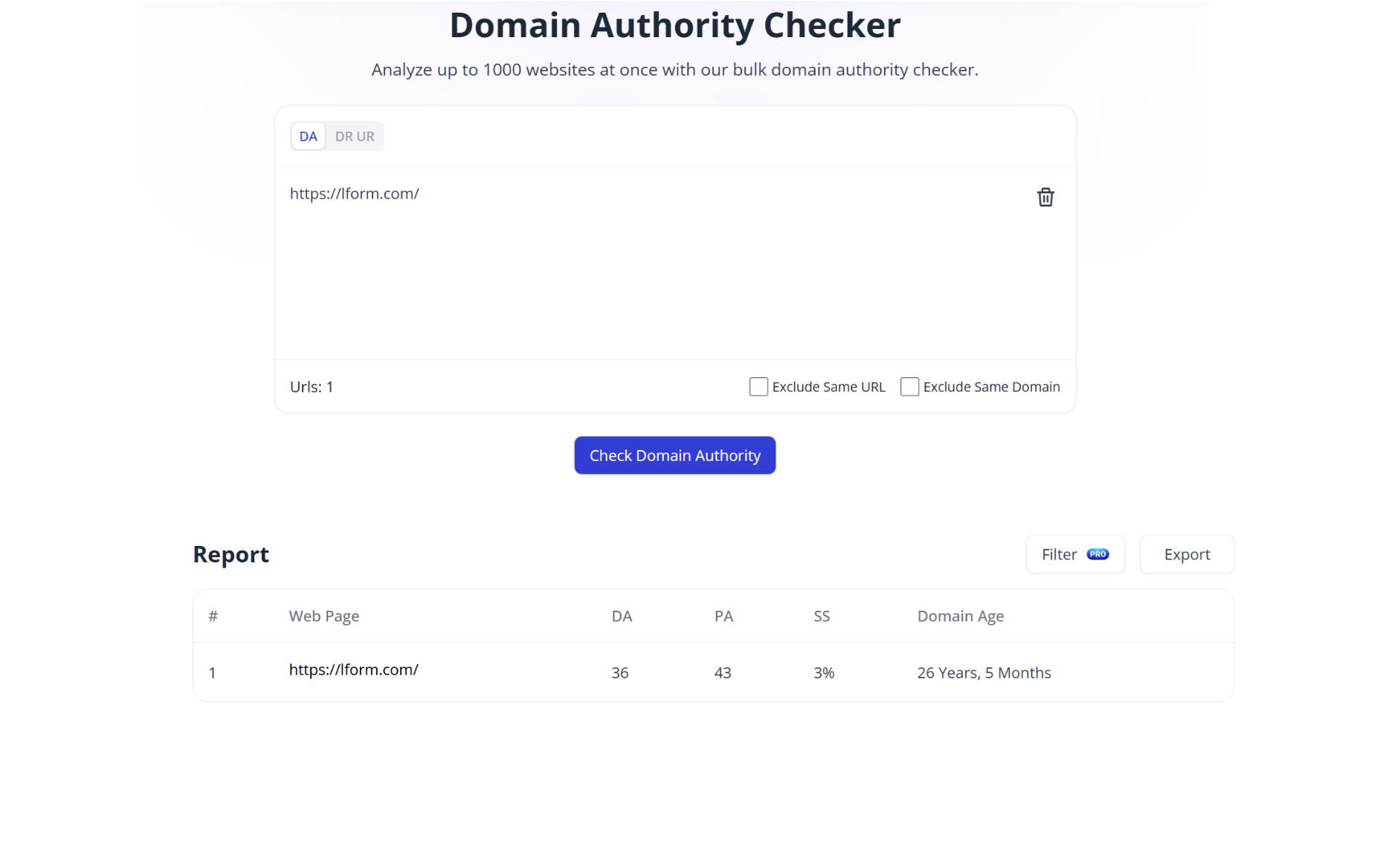
Measuring domain authority is simple with the DA Checker, which also shows other useful metrics such as spam score, page authority, and domain age.
Technical Performance
Technical performance is another important factor that significantly influences search engines’ trust in a manufacturing website. Google favors websites with strong technical performance because technical stability allows sites to offer a smooth browsing experience to visitors. Ideally, this should be addressed during website development; building on a solid technical foundation is far easier than fixing performance issues after launch.
That said, if your current site wasn’t built with technical performance in mind, a thorough technical SEO audit is a good starting point. It will surface the issues with the highest impact on crawlability, speed, and user experience, so fixes can be prioritized without a full rebuild.
No matter how much quality content or how many products your manufacturing site carries, if it is not working well, it will struggle to win trust and rank higher.
Below, we have briefly explained some key pillars of a site’s technical health.
Site speed: Since manufacturing websites contain a large number of catalogs and images, load times can suffer if assets aren’t optimized. Steps like compressing images and implementing lazy loading keep load times fast.
Mobile responsiveness: Your site needs to function properly across all devices, including desktop, tablet, and mobile, to maintain usability and search engine trust.
Structure: Clear navigation, organized categories, and structured internal linking make it easier for Google to understand the site hierarchy for regular crawling.
Maintaining good site health ensures your manufacturing website delivers a seamless experience to visitors and builds trust with both your audience and search engines.
User Experience (UX) Signals

User experience is also a fundamental factor that impacts a search engine’s trust in a manufacturing site. It refers to how the target audience interacts with the website and how satisfied they are with that experience.
Google usually considers the following signals to evaluate the user experience of a manufacturing website.
Engagement levels: When a potential buyer spends time reading content, exploring different products, and pages, it signals they find it genuine and useful. Google reads that engagement as a signal that the content is relevant and useful.
Bounce rate: It is the percentage of visitors who leave the manufacturing website immediately after visiting it. Search engines view this as a negative signal.
Search engines also weigh interaction signals, such as clicks and return visit rate, when assessing overall site trustworthiness.
Bottom Line
Search engines like Google usually rank websites higher in SERPs that they trust. For manufacturing websites, trust isn’t built overnight. It comes from consistent technical performance, credible content, quality backlinks, and a user experience that keeps buyers engaged. Invest in these areas, and search engines will take notice.
About Atif Shahzad

Atif Shahzad is an SEO enthusiast with a strong interest in search engine optimization. He specializes in topics related to technical SEO, content strategy, website authority, and search engine rankings. With a deep understanding of how Google evaluates websites, he creates content that helps websites improve online visibility, strengthen credibility, and drive organic traffic