
Answer Engine Optimization Services for Manufacturers
Answer engine optimization, or AEO, is the practice of structuring and optimizing your digital content so that AI-powered platforms can find it, understand it, and use it as a source when generating responses to user queries.
Traditional search engines return a list of links. Answer engines return a direct response. That shift changes what it means to be visible online. Ranking on page one of Google still matters, but appearing as a cited source in an AI-generated answer is a distinct opportunity that requires its own strategy.
AEO focuses on making your content machine-readable and authoritative: clear structure, well-defined entities, accurate and specific information, and the kind of depth that signals expertise to both human readers and the models that learn from them.
For manufacturing companies, that matters more than it might seem. Industrial buyers are increasingly turning to AI-powered tools like ChatGPT, Perplexity, and Google’s AI Overviews to get direct answers to their questions before they ever visit a website. If your company is not showing up in those answers, you are invisible at one of the most critical moments in the buying process.
At Lform, we offer answer engine optimization services designed specifically for manufacturers. Our goal is straightforward: when an AI tool answers a question relevant to your business, your brand should be part of that answer.
Start Showing Up in AI Answers
How Large Language Models Decide What to Surface
Large language models, or LLMs, are trained on vast datasets of text from across the web. They learn to recognize which sources are authoritative, consistent, and structured clearly enough to be reliable. When a user asks a question, the model draws on that training to generate a response and, in some platforms, surfaces citations from sources it considers credible.
Several signals influence whether your brand gets surfaced:
- Topical authority: Consistent, in-depth content on a focused subject area tells models that your site is a reliable source on that topic.
- Citation patterns: When reputable external sources reference your content, that reinforces your authority in the model’s learned understanding of the web.
- Content clarity and specificity: Vague or generic content is less likely to be surfaced. Precise, well-organized answers to real questions perform better.
For manufacturers, this means that the quality and structure of your website content directly affect whether AI tools recommend your company when a buyer is researching solutions in your space.
What Platforms AEO Actions Impact
Answer engine optimization is not limited to a single platform. Effective AEO improves your visibility across the growing ecosystem of AI-powered search and discovery tools, including:
- Google AI Overviews — the AI-generated summaries that now appear above traditional search results for many queries
- ChatGPT — used increasingly by B2B buyers to research industries, vendors, and technical specifications
- Perplexity AI — a search-native AI platform that cites sources directly and is gaining traction among research-oriented users
- Microsoft Copilot — integrated into Bing and Microsoft 365, surfacing answers for business users across productivity tools
- Google Gemini — Google’s AI assistant, deeply integrated into Search and Workspace
Each platform has its own characteristics, but the underlying optimization principles overlap significantly. A well-structured, authoritative website that demonstrates topical expertise positions you effectively across all of them.
How AEO Affects the Manufacturing Buying Journey
Industrial buyers do not make fast decisions. A procurement manager researching a new supplier or a plant engineer evaluating a technical solution will spend weeks, sometimes months, gathering information before reaching out to a vendor. That research process now frequently includes AI-generated answers.
A buyer might ask an AI tool: “What should I look for in a contract manufacturer for precision-machined parts?” or “Which industrial coating companies serve the automotive sector?” If your company’s content is structured to answer those kinds of questions clearly and authoritatively, you have a real opportunity to be named or referenced at the start of that research process, long before the buyer fills out a contact form.
For manufacturing companies, AEO is not a branding exercise. It is a lead-generation strategy applied to the stage of the buying journey before the buyer announces themselves.
AEO, SEO, and GEO: Understanding the Differences
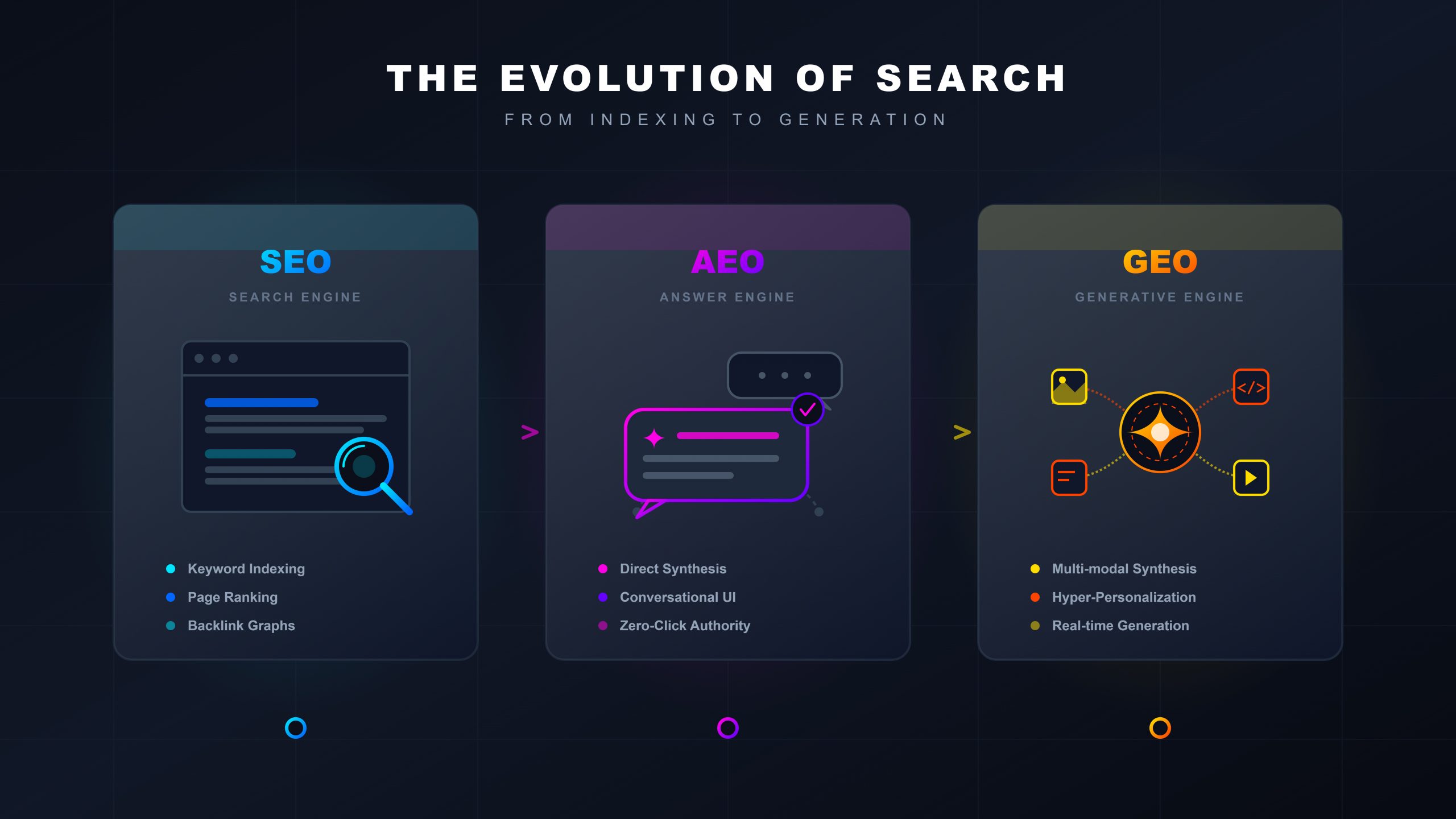
These three disciplines are related but distinct, and confusing them leads to gaps in strategy.
SEO (Search Engine Optimization) focuses on improving your visibility in traditional search engine results pages. It governs ranking factors like backlinks, page speed, keyword targeting, and technical site health. SEO remains the foundation of organic digital visibility.
GEO (Generative Engine Optimization) focuses on optimizing content for generative AI platforms specifically, with an emphasis on how AI systems synthesize and present information. GEO often overlaps with AEO but tends to focus more on how content is framed for AI consumption at a generative level.
AEO sits at the intersection of both. It focuses on making your content the source that answer engines pull from when responding to direct questions. Where SEO earns you a ranking, AEO earns you a citation or a direct mention inside an AI-generated response.
The three disciplines reinforce each other, and a coherent strategy accounts for all of them.
Why AEO, SEO, and GEO Work Best Together
AI-powered search is growing, but Google still processes an estimated 16.4 billion searches per day, according to DemandSage. Organic search traffic remains a significant and measurable driver of leads for manufacturing companies. Abandoning SEO to chase AI visibility would be premature and strategically unsound.
The right approach treats AEO, SEO, and GEO as complementary. Strong technical SEO lays the foundation for AEO and GEO to work. High-quality, well-structured content optimized for answer engines also ranks well in traditional search. The signals overlap: topical authority and content depth serve all three disciplines simultaneously.
Our services for manufacturers are built around this integrated approach. We do not optimize for one channel at the expense of others. We build a digital presence that performs across the full spectrum of how industrial buyers find information today.
What AEO Actions Look Like in Practice
Implementing answer engine optimization services on a manufacturer’s website involves a specific set of technical and content-level actions. This is not a single fix but an ongoing discipline.
Visibility and Content Audit
The process starts with understanding where you stand. We audit your existing content to identify gaps in topical coverage, assess how well your pages answer the questions your buyers are actually asking, and evaluate whether your site structure supports machine readability.
LLMs.txt Implementation
We implement LLMs.txt files on your website, an emerging standard that gives AI systems a structured, crawlable summary of who you are, what you do, and what content on your site is most relevant. Where a sitemap speaks to search engine crawlers, LLMs.txt speaks directly to large language models. For manufacturers with complex product lines or multiple served industries, it is a direct way to control how AI systems understand and represent your business.
Content Development for Answer Intent
We develop and optimize content specifically designed to answer the direct questions your buyers ask at every stage of their research process. This includes long-form service pages, technical explainers, and supporting content that builds topical authority around your core capabilities.
Content Structure and Entity Optimization
Many manufacturers have websites with strong technical credentials but thin, unstructured content. A page that lists services without context, uses inconsistent terminology, or lacks the depth to answer a real question will not perform well in AI-driven search, regardless of how strong the underlying business is.
Entity optimization is a key part of AEO. It means making sure that the people, products, processes, and capabilities associated with your business are clearly and consistently defined across your web presence. AI systems build a model of what your company does based on the language patterns they encounter across your site and the sources that reference you. Vague or inconsistent content creates ambiguity that works against you.
For manufacturers with complex product lines, multiple served industries, or specialized processes, entity optimization is an especially high-value investment. It turns the depth of your expertise into a signal that AI systems can actually read.
What Measurable Outcomes AEO Produces

AEO measurement is still maturing alongside the platforms it targets, but there are concrete indicators that reflect progress.
Metrics we track include: referral traffic from AI-powered platforms, brand mention frequency in AI-generated responses, organic visibility for question-based and long-tail queries, and engagement signals on content developed for answer intent. Share of Model, a developing metric that measures how frequently a brand appears in AI-generated responses within a given topic area, is also part of our evaluation of performance over time.
For manufacturing clients, we frame these outcomes in terms that connect to business results: qualified traffic growth, lead form submissions, and search visibility for the terms your buyers use when they are actively evaluating suppliers.
Why Manufacturing Companies Need AEO
Manufacturers face a specific challenge in digital search. The questions their buyers ask are often highly technical, the sales cycles are long, and the research process is thorough. Buyers want specific, credible information, and they are increasingly finding it through AI tools before they engage with any vendor directly.
A manufacturer without an AEO strategy is relying entirely on buyers finding them through traditional search or direct referral. That is a shrinking share of the total research process. The companies that will hold a competitive advantage over the next several years are the ones building authority now, while the platforms are still developing, and the competition for AI visibility is lower than it will be.
The manufacturers’ websites we build and optimize are designed with this trajectory in mind. Structure, content depth, and technical foundations are built to perform in the search environment that is taking shape, not just the one that existed five years ago.
Why Choose Lform for Answer Engine Optimization for Manufacturers

Since 2005, we have worked exclusively with manufacturing and industrial companies. That focus is not incidental. It means that when we develop an AEO strategy for a manufacturer, we understand the buying process, the technical complexity of the products, the distributor relationships, and the language your buyers use when they search.
Our team of SEO specialists brings focused expertise to every account. Every recommendation comes from practitioners who work directly in your project, with full visibility into your industry and your goals. We apply AEO within a broader digital strategy that includes SEO and web development, so optimization decisions are made with the full picture in mind.
We work with a focused client base, which means we stay current on how AI platforms are evolving and how those changes affect manufacturers specifically. AEO is moving fast. You need a partner who is tracking that movement, not one catching up to it.
Built for Where Search Is Going
Answer engine optimization services represent one of the most significant shifts in digital visibility since mobile changed how people access the web. For manufacturing companies, the opportunity is real, and the window to build early authority is open now.
We help manufacturers get found where their buyers are looking, whether that is a traditional search results page or an AI-generated answer. If you are ready to build a digital presence that performs across both, schedule a needs assessment, and let’s talk about where your company stands today. Or, if you have questions about our approach and want to understand what AEO would look like for your specific business, contact our team directly.
What Manufacturers Ask About Answer Engine Optimization
What is answer engine optimization?
Answer engine optimization, or AEO, is the practice of structuring and optimizing your website content so that AI-powered platforms can find it, understand it, and use it as a source when generating direct responses to user queries. Where traditional search engines return a list of links, answer engines return a direct answer. AEO is the discipline of making sure your business is the one being cited in those answers.
What is an answer engine?
An answer engine is a platform that responds to user queries with a direct, synthesized answer rather than a list of links. Examples include ChatGPT, Perplexity, Google AI Overviews, and Microsoft Copilot. These platforms pull from indexed web content, prioritizing sources that are authoritative, clearly structured, and relevant to the question being asked.
How does answer engine optimization work?
AEO works by making your content easier for AI systems to parse, evaluate, and cite. This involves optimizing content structure, building topical authority around your core capabilities, implementing LLMs.txt to guide AI crawlers, and developing content that directly answers the questions your buyers are asking. The goal is to position your website as a reliable, authoritative source that AI platforms return to consistently.
Which AI platforms does AEO target?
AEO improves your visibility across the growing ecosystem of AI-powered search tools, including Google AI Overviews, ChatGPT, Perplexity, Microsoft Copilot, and Google Gemini. Each platform has its own characteristics, but the underlying optimization principles overlap significantly. A well-structured, authoritative website performs better across all of them.
Is answer engine optimization and generative engine optimization the same?
They are related but not identical. GEO, or generative engine optimization, focuses on how content is framed and synthesized for generative AI platforms, with an emphasis on how AI systems process and present information. AEO focuses specifically on earning citations and direct mentions inside AI-generated responses to user queries. In practice, the two disciplines share many of the same tactics, and a strong strategy accounts for both.
What are some strategies for implementing answer engine optimization?
Core AEO strategies include building topical authority through consistent, in-depth content on your subject area, optimizing content to directly answer the questions your buyers ask, implementing LLMs.txt to make your site more accessible to AI crawlers, and ensuring your content is clearly structured with a logical heading hierarchy. A visibility and content audit is typically the right starting point, as it identifies where your current content falls short and where the biggest opportunities lie.
How to structure a page for AEO?
For manufacturing websites, page structure plays a significant role in AEO performance. AI systems favor content that is organized around clear questions and direct answers, uses a logical heading hierarchy, and covers a topic with enough depth to signal genuine expertise. Thin pages that list services without context, or that use inconsistent terminology, are less likely to be surfaced. The specifics of an effective AEO page structure depend on your industry, your content gaps, and how your buyers search, which is why we start every engagement with a content audit before making structural recommendations.
Should I stop SEO and focus on AEO?
No. Google still processes billions of searches every day, and organic search remains one of the most reliable sources of qualified traffic for manufacturing companies. Abandoning SEO to chase AI visibility would be premature. The stronger approach is to treat AEO, SEO, and GEO as complementary disciplines. The signals that help you rank in traditional search, topical authority, content depth, and technical site health are the same signals that improve your visibility in AI-generated answers.
Should AEO, SEO, and GEO be part of the same strategy?
Yes, and separating them creates gaps. SEO builds the technical and content foundation that makes AEO and GEO work. High-quality content optimized for answer engines also tends to rank well in traditional search. GEO ensures your content is framed effectively for generative platforms. The three disciplines reinforce each other, and the manufacturers who will hold a competitive advantage are the ones building an integrated strategy now, rather than treating each as a separate initiative.
Is answer engine optimization worth it for manufacturers?
For manufacturing companies specifically, AEO addresses a real gap in how industrial buyers research suppliers. Procurement managers and engineers increasingly use AI tools to answer technical questions and evaluate vendors before they ever contact a company directly. A manufacturer without an AEO strategy is absent from that part of the buying process. The companies building AI visibility now are doing so while competition for that visibility is still relatively low, which makes the investment more efficient than it will be in two or three years.
Can AEO help manufacturers generate leads?
Yes, though the mechanism is different from traditional lead generation. AEO positions your company as a cited source in the AI-generated answers your buyers encounter during the research phase of their buying journey. That means your brand enters the conversation earlier, before the buyer has shortlisted vendors or filled out a contact form. Over time, consistent visibility in AI-generated answers builds brand familiarity and trust that translates into qualified inquiries.
How does AEO support long sales cycles in manufacturing?
Industrial buying cycles are long because the decisions are high-stakes and the research is thorough. Buyers spend significant time gathering information before engaging with any vendor. AEO extends your visibility into the earliest stages of that research process, when buyers are asking broad questions about capabilities, processes, and what to look for in a supplier. Being present at that stage, even as a referenced source rather than a direct result, builds the kind of familiarity that influences decisions made weeks or months later.
What types of manufacturing content perform best in AI-generated answers?
Content that performs well tends to be specific, well-organized, and genuinely useful to a technical reader. This includes detailed service and capability pages that explain processes clearly, content that addresses common buyer questions about specifications, tolerances, lead times, and industry certifications, and pages that cover topics with enough depth to demonstrate real expertise. Generic content that could apply to any industry performs poorly. The more your content reflects the specifics of your manufacturing niche, the stronger it will perform.
Do industrial buyers actually use AI search tools to find suppliers?
Increasingly, yes. While referrals and direct outreach remain important in manufacturing, the research phase of the buying journey is shifting. Procurement managers and engineers are using tools like ChatGPT and Perplexity to answer technical questions, compare options, and build shortlists before engaging vendors directly. That shift is still developing, but manufacturers who build AI visibility now will be better positioned as the behavior becomes standard.
What is LLMs.txt, and why does it matter for AEO?
LLMs.txt is an emerging standard that allows website owners to provide AI systems with a structured, crawlable summary of their site’s content and purpose. It functions as a guide for large language models, telling them who you are, what you do, and which pages on your site are most relevant. For manufacturers with complex product lines or multiple served industries, LLMs.txt is a direct way to influence how AI systems understand and represent your business when responding to relevant queries.
Does my manufacturing website need to be rebuilt to implement AEO?
Not necessarily. Many AEO improvements can be applied to an existing site, including content restructuring, LLMs.txt implementation, and targeted content development. That said, if your current site has significant structural problems, thin content across core pages, or a poor technical foundation, those issues will limit how far AEO can take you. A content and visibility audit is the right first step to determine what your site needs before committing to a specific scope of work.
How does site structure affect AEO performance?
Site structure affects how easily AI systems can crawl, parse, and understand your content. A well-organized site with a clear hierarchy, logical internal linking, and pages that cover distinct topics without overlapping gives AI platforms a cleaner picture of what your business does and where your expertise lies. Poorly structured sites, where content is scattered, duplicated, or buried under unclear navigation, create ambiguity that works against you in AI-driven search.
Can a small or mid-size manufacturer benefit from AEO?
Yes, and smaller manufacturers stand to benefit more from early investment in AEO. Larger competitors with established domain authority already have an advantage in traditional search. AI-driven search is a newer landscape where topical authority and content quality matter more than domain size. A focused mid-size manufacturer that builds genuine expertise around a specific niche and structures that expertise clearly on their website can earn AI visibility that would be difficult to achieve through SEO alone.
How do I measure the results of answer engine optimization?
AEO measurement is still maturing alongside the platforms it targets, but there are concrete indicators to track. These include referral traffic from AI-powered platforms, organic visibility growth for question-based and long-tail queries, and engagement signals on content developed for answer intent. Brand mention frequency in AI-generated responses can be tracked through manual sampling and emerging monitoring tools. Share of Model, a developing metric that measures how often your brand appears in AI responses within a given topic area, is also part of how we evaluate performance over time.
Can a slow website harm answer engine visibility?
Yes. Page speed and overall site performance affect how efficiently AI crawlers can access and process your content. A slow website creates friction for both human visitors and automated systems. If pages take too long to load or are inconsistently accessible, crawlers may deprioritize your content in favor of faster, more reliable sources. Beyond crawlability, slow sites tend to have weaker technical foundations overall, which compounds the problem across both traditional SEO and AEO performance.